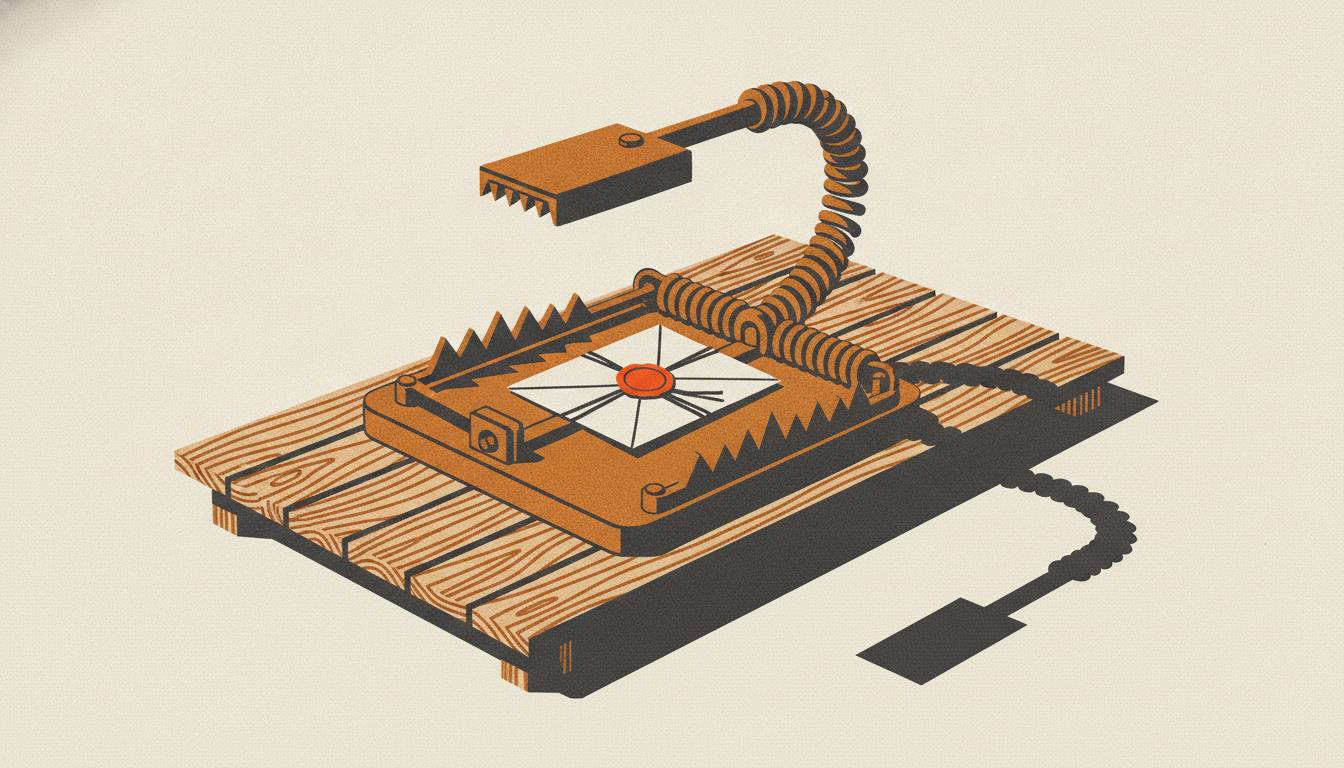
"You are owed $18,412.67. To release your refund, scan the code below within 10 business days."
The envelope looks federal. Eagle-blue header, a case number, "IEEPA Duty Refund: Final Notice" in bold.
Maya runs a candle shop out of a rented warehouse bay. Last year she paid tariffs on three containers of glass jars and never thought she'd see that money again. Now this letter lists her real entry number. It names the port her jars came through.
The QR code leads to a form. It asks for her ACE login, her deposit account, and a $1,450 "release fee."
She has her phone out before she finishes the paragraph.
Maya and her letter are a composite. The scam isn't. U.S. Customs and Border Protection says it is seeing "an increasing trend of suspicious mailers, flyers, and notices" aimed at importers, and in August its trade office warned that fake letters claiming to be from CBP were offering "refund assistance." A trade law firm reported clients getting letters and emails that cited their specific import activity and pushed them to call a number, visit a site, or scan a QR code.
Here's why it works. On February 20, 2026, the Supreme Court ruled in Learning Resources v. Trump that the tariffs imposed under IEEPA, the emergency powers law, were unlawful. CBP estimates those tariffs totaled about $166 billion across more than 53 million entry summaries. Refunds with interest are real and flowing now. And CBP says most small businesses don't even have an ACE account, the portal where those refunds live. That's the gap the letter is built to fill.
Red flags
- It wants your ACE password or bank details. CBP says it generally won't ask for Social Security numbers, bank account details or passwords by email or text.
- There's a fee. CBP's own FAQ says it charges no fees to process tariff refunds. A "release," "processing" or "filing" fee from anyone claiming to be CBP is a scam.
- It sends you to a website or a QR code. The only way to request an IEEPA refund is a CAPE Declaration filed inside the ACE Portal. CBP says not to enter anything on a site that claims to process IEEPA refunds if it isn't the ACE Portal.
- It shows up unasked with "status updates." CBP says it will not email CAPE refund updates or reports. You pull those yourself in ACE.
- Real details, fake sender. The trade law firm's advice is blunt: don't treat the detail in a letter as proof it's legitimate or official.
- A countdown. "Within 10 business days" is pressure, and pressure is on CBP's own watch list.
What to do
- Don't scan, click or call anything in the letter. Keep it as evidence.
- Call your licensed customs broker at the number on an old invoice, not one in the letter. CBP says most small businesses don't have an ACE account and are expected to use their customs broker for refunds. Only you as the importer of record, or the licensed customs broker who filed your entries, can file a CAPE Declaration. Not a "refund center," and not even an attorney.
- If you have an ACE account, check it yourself. The ES-022 report shows your CAPE claims and refund amounts. CBP says valid refunds generally land 60 to 90 days after a declaration is accepted, by ACH to the bank account on file in ACE.
- Already gave something up? Change your ACE password and remove old users. If you shared bank info, call your bank today. If you paid a fee, ask your bank or card company to reverse it right away.
- Report it. Email the letter to IEEPAFraud@cbp.dhs.gov, then file at ReportFraud.FTC.gov and with your state attorney general (find yours at naag.org).
Some real firms do sell legitimate refund help, and their letters can look similar. The test is simple. CBP says never share your ACE password, and your refund only goes by ACH to the bank account on file in ACE. Nobody needs a fee to change that.
Maya's money is real. It just only comes from one door.
Sources:
- CBP, IEEPA Duty Refunds (FAQ: fees, email updates, who can file, timing)
- CBP, Fact Sheet: CAPE Refund Fraud Solicitation
- Federal Register, CBP notice on court-ordered IEEPA refunds (Oct. 5, 2026)
- Supreme Court, Learning Resources, Inc. v. Trump (Feb. 20, 2026)
- CBP Office of Trade, "Avoid IEEPA refund scams" (Aug. 2026)
- Parker Poe, Importers Should Exercise Caution Regarding Unsolicited IEEPA Tariff Refund Communications (June 17, 2026)
- FTC, Scams and Your Small Business