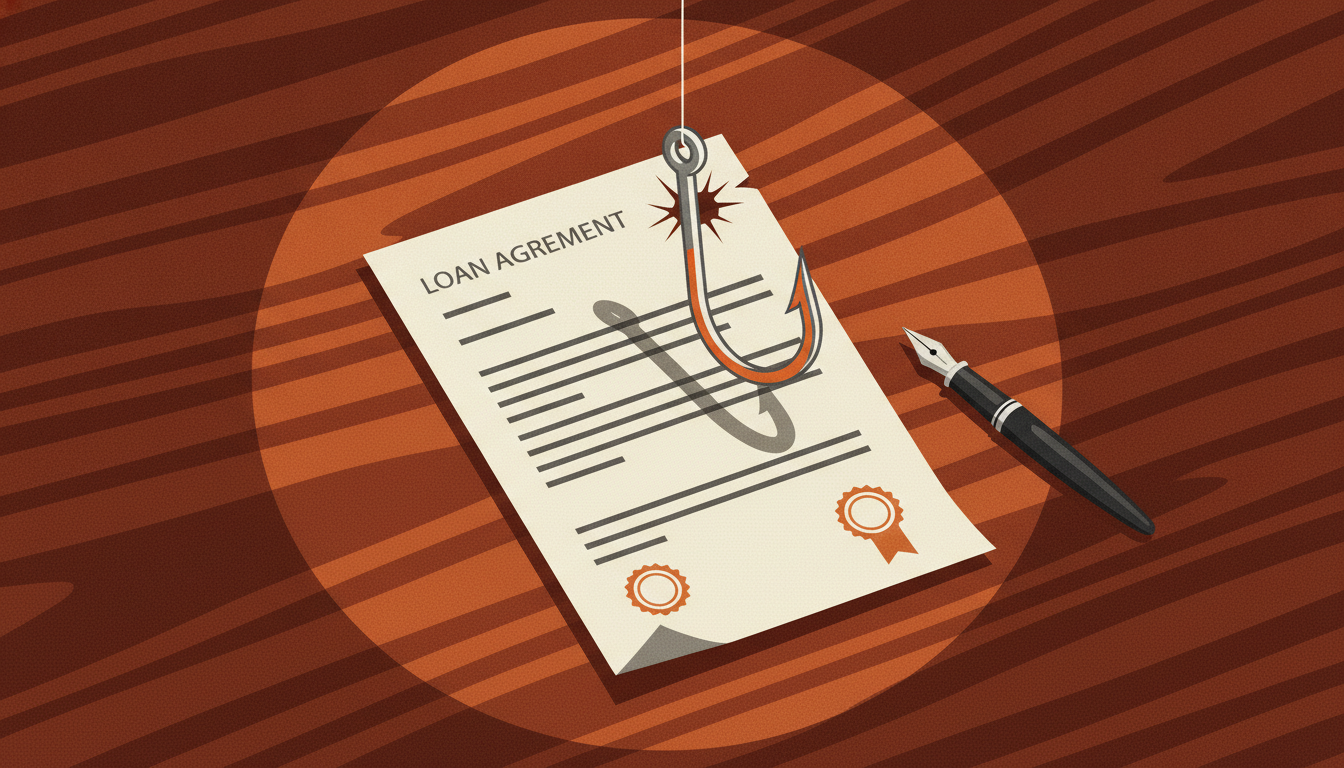
"We only get paid if you get funded. Five percent at closing, that's it."
It sounds fair. On a $300,000 SBA 7(a) loan, that's a $15,000 check. And it's a fee the SBA doesn't allow.
The one rule to know before you let anyone "package" your 7(a): SBA bans contingency fees. That's a fee you pay only if the loan is approved or closes. It also caps what a packager or broker can charge you, and every fee has to be disclosed on a federal form.
The rule, from the SBA rulebook
SBA's lending rulebook is SOP 50 10 8.1, which took effect October 1, 2026. The agent rules sit in Section A, Chapter 4, and the regulation behind them is 13 CFR Part 103. In plain English:
You never need an agent. The lender has to tell you that in writing before any agent works on your file.
No contingency fees, and no flat fee charged to every applicant.
A fee based on a percentage of the loan can't be more than 3% on loans of $50,000 or less. Above that, the cap is 2% up to $1,000,000 and 0.25% on anything over $1,000,000, with a $30,000 maximum.
An agent who charges you more than $2,500 has to back it up with an itemized list of the work they did.
Every agent fee goes on SBA Form 159, which you, the agent and the lender all sign.
The math on a real-sized deal
Say you run a landscaping company and need a $300,000 7(a) for two trucks and working capital.
The broker's pitch: 5% "success fee" = $15,000, due only if it closes. That's contingent, so SBA doesn't allow it.
The SBA ceiling on a percentage fee: 2% of $300,000 = $6,000. And it has to be for packaging work that was actually done.
The gap: $9,000. That's how much the pitch is over the cap.
The real cost: on a 10-year loan at 10.5%, $9,000 of extra borrowing is about $121 a month, or roughly $14,500 over the life of the loan.
The worst version doesn't stop at a fee. The broker "can't get the SBA done," and your file turns into a daily-debit merchant cash advance at a 1.35 factor rate. Run it through our factor-rate calculator before you sign anything.
What the loan itself looks like
Here's how a real 7(a) is set up under SOP 50 10 8.1:
Size: up to $5,000,000. Loans of $350,000 or less are "7(a) Small." SBA Express tops out at $500,000.
Rate caps on variable loans: Prime + 3.0% above $350,000, and up to Prime + 6.5% on loans of $50,000 or less.
Cash flow test: for a 7(a) Small loan (not a business purchase), debt service coverage has to be at least 1.10x. Standard 7(a) loans need 1.15x.
Credit score: SBA sets no FICO minimum. A "680 minimum" is a lender overlay, not an SBA rule. Ask the lender which it is.
Do this before you sign anything
Ask the person helping you: "Will you sign an SBA Form 159 with your fee on it?" If they won't, walk away.
Get the fee in writing as a dollar amount, with what it covers. If it's over $2,500, ask for the itemized list.
If any part of the fee depends on closing, say no.
Find an SBA lender yourself through SBA's Lender Match.
If they push a cash advance "while the SBA cooks," hang up. Then send a cease-and-desist if the calls keep coming.
Lenders can add their own requirements on top of SBA's. Ask your lender which SOP version your loan falls under, too. Loans that got an SBA loan number before October 1, 2026 stay on 8.0.
