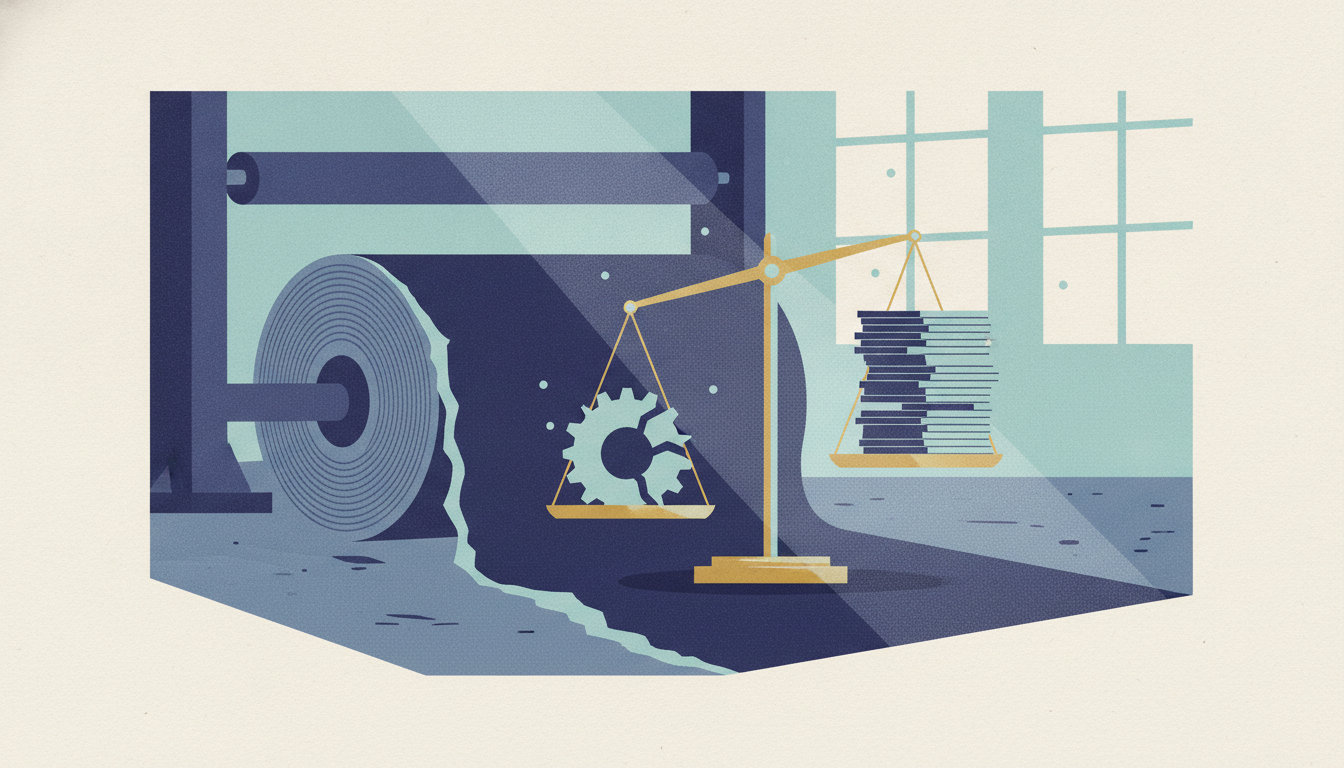
Clearwater Paper Corporation (NYSE: CLW), a maker of bleached paperboard for cups and cartons, fell 28.8% on October 27, 2026 and another 3.9% on October 28 after its Augusta, Georgia mill problems pushed fourth-quarter guidance below Wall Street estimates. Kingdom Capital Advisors, a small-cap special situations firm, says the only deal Clearwater Paper should pursue is selling itself to realize book value of about $49 a share. Another value investor calls Clearwater Paper an easy target for an activist, noting that all eight board seats are up at the 2027 annual meeting.
This is journalism and commentary, not investment advice. We hold no position unless stated.
Key facts
- Ticker: CLW on the New York Stock Exchange; situation type is a broken small cap with a possible activist or sale angle.
- The call: Kingdom Capital Advisors wants a sale "to realize that $50/share of book value"; no position stated.
- Price: $19.22 at the October 26, 2026 close; $13.69 at the October 27, 2026 close, a drop of 28.8%; $13.15 at the October 28 close, down another 3.9%; $13.40 at the November 3 close.
- Book value: stockholders' equity of $794.2 million at September 30, 2026, or about $49 a share on 16.1 million weighted shares.
- Debt: net debt of $260.7 million at September 30, 2026, after a refinancing that pushed maturities to 2031.
- Guidance: fourth-quarter 2026 adjusted EBITDA of $10 million to $20 million, versus a Street estimate of $20.5 million.
- Main risk: the Augusta mill needs more money, with a January 2027 outage costing $12 million to $15 million.
Is CLW a good bet right now?
The case for Clearwater Paper is a deep discount to its assets. At the November 3 close of $13.40, the stock traded at about 27% of book value.
The case against is that book value is only worth what the mills earn. Clearwater Paper lost $35.9 million from continuing operations in the first nine months of 2026, and its third-quarter adjusted EBITDA of $24.4 million leaned on a one-time insurance payment.
Why are investors bullish on Clearwater Paper?
- Asset discount. By our math, Clearwater Paper's market value was about $216 million at $13.40, against $794.2 million of equity.
- Prices are rising. The first $60 per ton price increase is fully in place and a second is being pushed through, per CEO Arsen Kitch.
- Big operating leverage. Kitch said that if all announced increases stick across all tons, the adjusted EBITDA run rate would improve by nearly $200 million, Packaging Dive reported.
- Past interest. In December 2024, Bloomberg reported that Suzano was exploring an offer for Clearwater Paper; Suzano said no agreement had been reached.
Who's making this call and why?
Kingdom Capital Advisors publishes quarterly letters on small-cap special situations. After the drop, the firm posted a sarcastic note on management's "value creation." In a reply about doing M&A, the firm wrote: "Yeah the selling kind, lets realize that $50/share of book value."
Track record. In our tracking, Kingdom Capital is 4-14 (a .222 win rate) on 18 calls scored at 180 days against the S&P 500. Its average edge is -17.3 points and its last 10 scored calls went 2-8. See the scoreboard.
Other supporters: Lee Roach, who writes about cheap small caps, wrote: "Clearwater Paper $CLW is a sitting duck for an aggressive activist." Roach says there is no poison pill, management owns about 2% of the shares, and say-on-pay support has fallen four years in a row. He estimates a sale at about $560 per ton could fetch about $31 a share. Those are his claims and estimates.
RBC Capital kept an Outperform rating while cutting its target to $22 from $23, per Investing.com.
Who disagrees?
We did not find a reasoned short case on X. Sell-side analysts were cautious:
- Truist kept a Hold rating and cut its target to $17 from $20, per Investing.com. Truist estimates 2027 EBITDA near $84 million.
- BofA kept a Neutral rating and cut its target to $21 from $25, per TipRanks, citing Augusta maintenance and higher interest costs.
The bear points are concrete:
- Augusta keeps breaking. Electrical and mechanical failures hit the mill in late September and continued into October.
- More spending. A January 2027 outage at $12 million to $15 million, plus likely 2027 downtime at $7 million to $10 million.
- Insurance is done. The $17.5 million third-quarter payment was the final one, for $73 million in total.
- Leadership change. Chief financial officer Sherri Baker will resign effective November 13, 2026, per an SEC filing.
- Leverage. By our math, net debt is about 3.1x Truist's 2027 EBITDA estimate.
What are the key facts to verify?
- Third-quarter results and balance sheet in the company release.
- Augusta outage costs and insurance totals in the Packaging Dive report.
- Proxy details Roach cites, such as the poison pill and say-on-pay votes, in Clearwater Paper's proxy filings.
- Any Schedule 13D filing, which would show an activist stake above 5%.
What would prove it right or wrong?
Signals the sale case is working:
- An activist 13D filing or a public letter to the board.
- A strategic review, or a bid from a larger paperboard or pulp producer.
- Fourth-quarter selling prices rising again as the second $60 per ton increase lands.
Signals it is wrong:
- More unplanned Augusta downtime before the January 2027 outage.
- Book value shrinking through losses or write-downs.
- 2027 EBITDA tracking well below Truist's $84 million estimate.
This is journalism and commentary, not investment advice. We hold no position unless stated.
