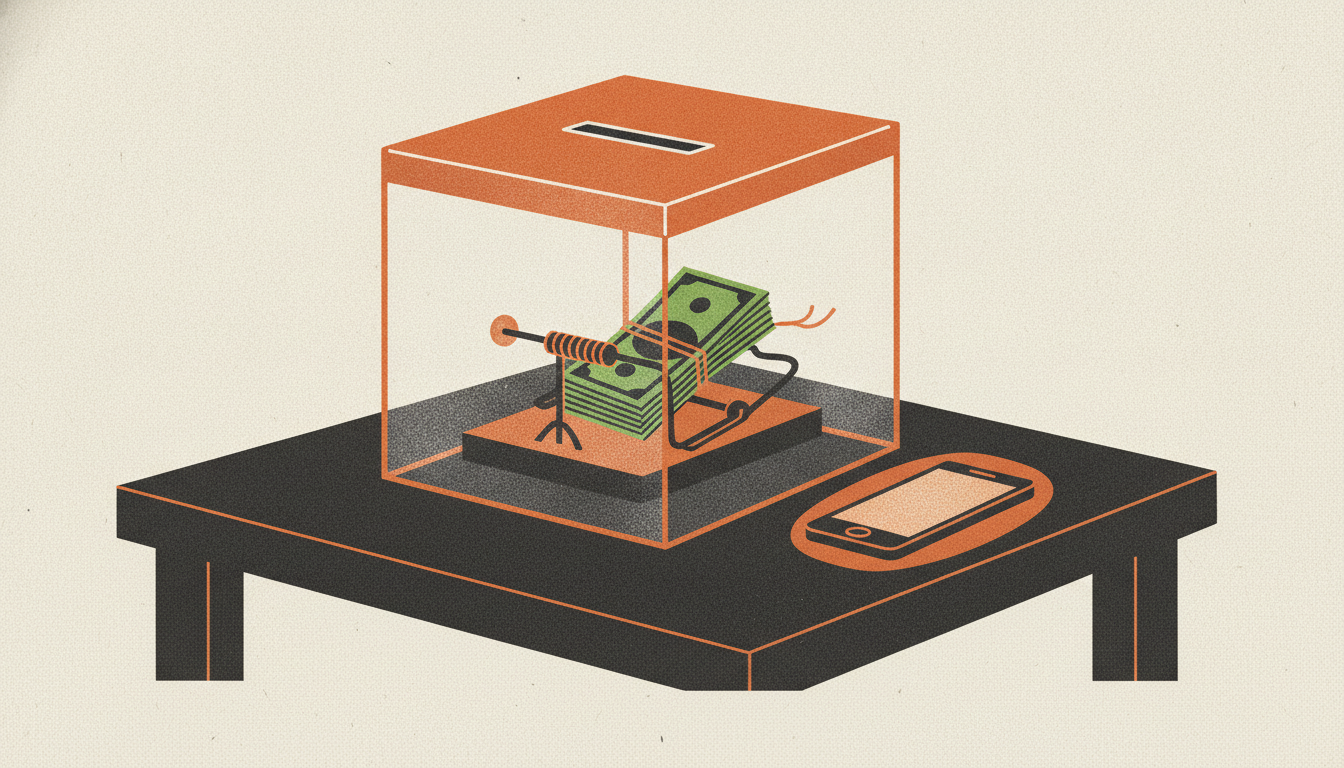
"Local owners are pooling for the race. $5,000 minimum. Guaranteed 2x payout the week after the win. Bring in two more owners and your share goes to 2.5x. Pool closes Monday at midnight."
Here's a hypothetical, and everyone in it is made up. Marco runs Ridgeback Heating & Air (a made-up HVAC shop) with four techs and two vans. It's the first cold week of the year, the phones haven't stopped, and his MCA funder pulls $412 from business checking every weekday.
The text lands Sunday night. It uses the candidate's real name, the real campaign logo and a slogan Marco has seen on yard signs all month. A link opens a slick page with a countdown clock and a short video of the candidate saying "small business built this town." The voice is right. The face is right.
Marco calls the number. The man who answers knows Marco's shop, his street and the guy who runs the plumbing supply down the road. "He's already in," he says. "Card or wire, business account is fine. We send the paperwork after."
Marco has the company card in his hand. Five grand now, ten grand in two weeks, and the guy at the supply house is in too.
Here's the turn. There is no pool. A campaign donation is not an investment, and nobody pays it back. The FBI says it plainly: contributions "will not increase in value nor be returned" (FBI IC3). And "business account is fine" gives it away too. Under federal law, an incorporated business can't give to a federal candidate from its business account. The FEC uses the exact example of a "mom and pop" grocery store owner, who has to use a personal account instead (FEC).
This one is live right now. On Oct. 15, 2026, the FBI warned that scammers are using the 2026 midterm election to run fraud schemes. It named the "campaign investment pool," which promises a guaranteed return after a candidate wins and pushes victims to recruit others. It also named fake PAC donation requests (it calls them ScamPACs), where the people asking have no tie to the committee and keep the money. The FBI says scammers are using AI tools to make realistic voices, images and messages that impersonate candidates and campaigns (FBI IC3). Election Day is Tuesday, Nov. 3, so expect the "last chance" pitches to peak now.
Red flags
Any "return" on a political donation. Campaign contributions don't grow and aren't returned (FBI IC3).
A payout that gets bigger if you recruit other owners. The FBI lists recruiting as part of the investment pool scheme (FBI IC3).
"Use the business account." Corporations can't make contributions to federal candidates from Treasury funds, and an LLC taxed as a corporation is treated the same way (FEC).
A committee you can't find on the FEC website, or one with odd filings. The FBI says some scam PACs may look registered, and heavy spending on fundraising, consulting or "compliance" can be a warning sign (FBI IC3).
A video or voice message from the candidate asking you for money directly. The FBI warns that AI can fake both (FBI IC3).
A countdown clock, a minimum buy-in and "paperwork after."
What to do
Don't pay through a link in a text, DM or email. If you want to give, go to the campaign's own website by typing it yourself, and give from your personal account.
Look the committee up on the FEC website before you give a dollar. Then make sure the phone number or site that contacted you actually belongs to that committee (FBI IC3).
Tell your office manager and anyone who holds a company card. These pitches go to whoever answers.
If you already paid, call your bank or card issuer right away and ask about disputing the charge or recalling the wire. Report it to the FBI's Internet Crime Complaint Center or your local FBI field office, with the phone numbers, website, payment method and what you were told (FBI IC3). You can also report it at ReportFraud.FTC.gov.
Marco didn't send it. He called the plumbing supply instead. The guy there had never heard of any pool. Marco's phone buzzed while they were still talking: "Pool closes in 2 hours. Your spot is still open."
