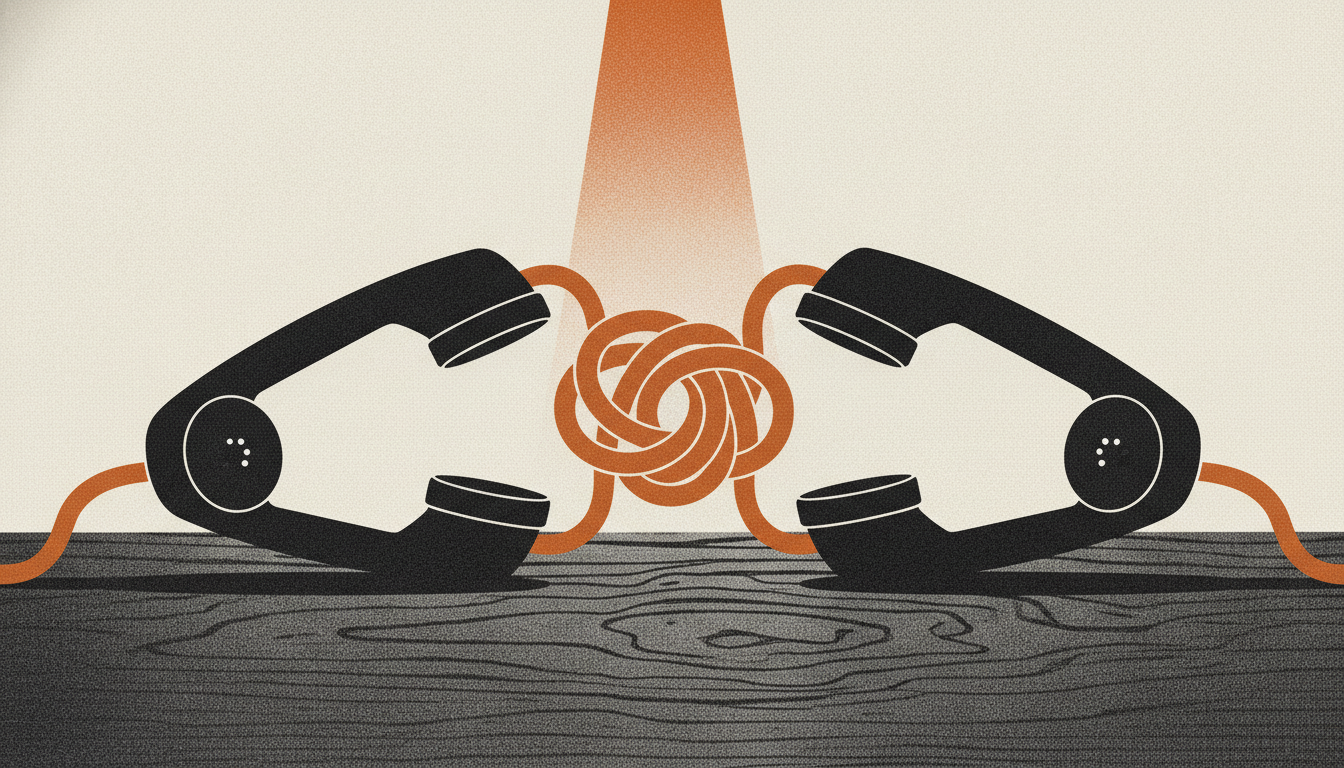
"Hi there! This is the funding desk. Great news, your business is pre-approved."
The voice is warm. It never says um. Your screener asks who is calling, and the voice talks right over the question. You are not on the line. Two machines are deciding your afternoon.
This is Part 15. Part 5 set up the screener and its greeting (https://mcafax.com/notebook/stop-the-calls-part-5-call-screening). Today: the rules the FCC already applies when the caller is an AI voice, and the stop script to give your receptionist for that call. New here? Every part is at https://mcafax.com/notebook/series/stop-the-calls
General information, not legal advice.
What the FCC already decided
In February 2024 the FCC ruled that calls using AI-generated voices, including voice cloning, use an "artificial" voice under the Telephone Consumer Protection Act (TCPA). That puts them under the same rules as prerecorded robocalls. The caller needs your prior express consent, and for telemarketing, prior express written consent. Ruling (FCC 24-17): https://docs.fcc.gov/public/attachments/FCC-24-17A1.pdf
The same ruling points to two duties in 47 CFR 64.1200(b). Every artificial or prerecorded voice message must state clearly, at the beginning, who is responsible for the call. A telemarketing message must also offer an opt-out so you can ask them to stop calling your number. Rule text: https://www.ecfr.gov/current/title-47/chapter-I/subchapter-B/part-64/subpart-L/section-64.1200
Now the honest limits. The consent rule in the statute covers cell phones, residential lines, and a few special lines (47 U.S.C. 227(b)(1)(A) and (B)): https://www.law.cornell.edu/uscode/text/47/227. A dedicated office landline may get less protection. The National Do Not Call Registry is for personal numbers, not business lines: https://consumer.ftc.gov/articles/national-do-not-call-registry-faqs. And your phone cannot prove a voice was AI. Your log records what the caller said and did.
The tactic: the bot-to-bot stop script
Paste this into whatever answers your shop line, after the Part 5 greeting:
"This line does not take calls about funding, working capital, or cash advances. Is this a live person or an automated voice? What is the legal name of the company responsible for this call? Put this number on your do-not-call list and do not call again. If you offer an opt-out, say it now."
Then give it four rules:
- Never warm-transfer a funding caller. "Returning your call" and "about your file" are not reasons to ring you. Take a name, company, and callback number. You call back only numbers you already have.
- Record the answer to "live or automated," word for word. No answer is an answer too.
- Note whether the company was named at the start of the call or only after it was asked.
- Flag any opt-out the caller names, such as "press 9" or a phone number. If your screener can't press keys, the flag tells you to use it yourself.
Add four columns to your log
Extend the Part 3 log (https://mcafax.com/notebook/toolkit/call-log-template):
- Voice: said live, said automated, or no answer.
- Named at start: yes or no.
- Opt-out offered: key, word, number, or none.
- Opt-out used: date and time.
That fourth column matters more soon. On Oct 1, 2026 the FCC released FCC 26-67, which lets callers designate an exclusive opt-out method, such as a key-press opt-out on the call, as long as they disclose it clearly. It takes effect 30 days after Federal Register publication, which had not happened as of Oct 17, 2026. Order: https://docs.fcc.gov/public/attachments/FCC-26-67A1.pdf. The habit now: use the method they name, and log it.
Your checklist
- Paste the stop script after your screener greeting.
- Turn off warm transfers for anyone pitching funding.
- Add the four columns and fill them from transcripts every Friday.
- Use any opt-out a caller names, then log it.
- Still calling? Send the written stop (https://mcafax.com/notebook/toolkit/cease-and-desist-letter) then report it: https://www.donotcall.gov/report.html for unwanted calls, https://reportfraud.ftc.gov if money was lost, and https://consumercomplaints.fcc.gov for robocalls.
More rights: https://mcafax.com/notebook/series/know-your-rights and https://mcafax.com/notebook/stop-mca-broker-calls
Coming in Part 16: the calls slow down and the emails start. What the federal email rules let you demand.