"You sound different tonight," Teo said.
"I haven't talked to you since Thursday."
"You called me twelve minutes ago."
I was in bed with the lights off and my phone at eleven percent, and I sat up so fast the charger cord popped out of the wall.
Teo is a locksmith. Two vans, two techs, and a hand-painted sign over his counter that says WE OPEN EVERYTHING EXCEPT ON TIME. He does lockouts at midnight, rekeys for landlords, and safes for widows who never learned the combination. His deposits run $38,000 to $47,000 a month. In the spring I'd funded him $30,000 at a 1.32. That's $39,600 back, $274 every business day. He had $11,212 left on it.
That was the exact number the other me had read to him, down to the dollar.
"You said the renewal's approved," Teo said. "Forty grand at a 1.29. Better than last time. You said I just have to Zelle twenty-four hundred tonight to release the old position, or the rate dies at midnight."
"Teo. Funders don't take Zelle."
"You said a guy might call pretending to be you," he said slowly. "You said he'd tell me funders don't take Zelle."
It was 11:41 p.m. Teo had $19,300 in his operating account and payroll for both techs on Friday. And if he decided I was the one robbing him, I'd lose a lot more than a renewal. Half the deals I'd closed in two years came from Teo telling other locksmiths at the supply house that I was the guy who didn't lie.
"Call him back," I said. "Merge me in. I'll stay muted."
He did. The other me picked up on the second ring.
My name came out of a stranger's mouth, warm and quick. He had a better phone voice than I do. He knew about the van with the smashed passenger window. He knew Teo's tech was named Benny. He said "let's get you clean," which is a thing I say when a merchant is close to paying off, and which I have only ever said to merchants and to one rep at one funder.
My stomach went cold. Somebody was renting out my book.
"Teo, buddy," the other me said. "Clock's ticking. Twenty-four hundred, and I'll have the forty in your account by nine."
Teo didn't answer him. He said, "You remember the key?"
A pause.
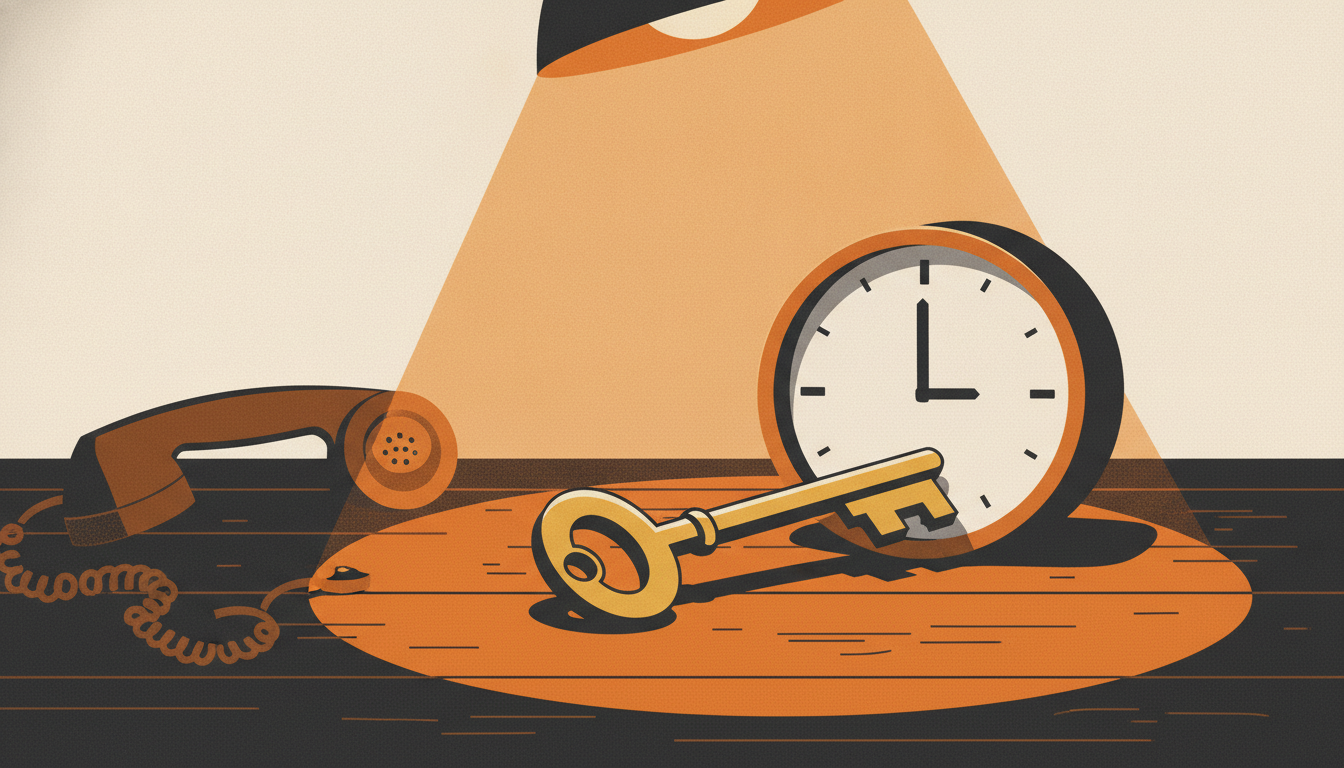
The first time I walked into his shop, Teo cut me a key on the spot. Brass, stamped with a number, threaded on a ring with a tiny plastic padlock. "Every customer gets one," he told me. "It opens nothing. It's so you remember I'm the guy who opens things." It had been on my keychain for fourteen months. It was in my fist right now.
"Of course I remember," the other me said. "Love that key."
"What's the number on it?"
"Teo. Come on. It's midnight. I don't have it on me."
"It's on your keychain. You told me you'd never take it off."
The line went quiet the way a garage goes quiet when the door finally hits the concrete.
Then the other me said, easy as anything, "Teo, hang up. Somebody else is on this call. I can hear him breathing. That's the scammer."
I watched the timer on my screen tick to 3:58. Teo didn't say anything. I could hear his van's blinker clicking, steady as a metronome. I had maybe five seconds before a man I'd known for fourteen months decided which of us was real.
I unmuted.
"Three-one-seven," I said.
Teo laughed, one short bark, sharp as a deadbolt sliding home.
The other me didn't even sigh. "Good book you've got, man," he said, to me now, not to Teo. "Lot of nice merchants in it." Then the line clicked and he was gone.
Teo didn't send the $2,400. He sat in his van in a grocery store lot and read me every text the guy had sent, and I wrote them down on the back of an envelope in the dark.
At 12:20 I called the number back. It rang four times and went to voicemail.
The greeting was my name, in his voice. "Hey, you've reached me. I'm on with a funder, but leave your number and I'll get you clean."
I didn't leave a message.
At 8:02 the next morning Teo texted me a photo. It was a brand-new brass key on his workbench, still shiny from the cutter, stamped 318.
"New number," he wrote. "Don't tell anybody."