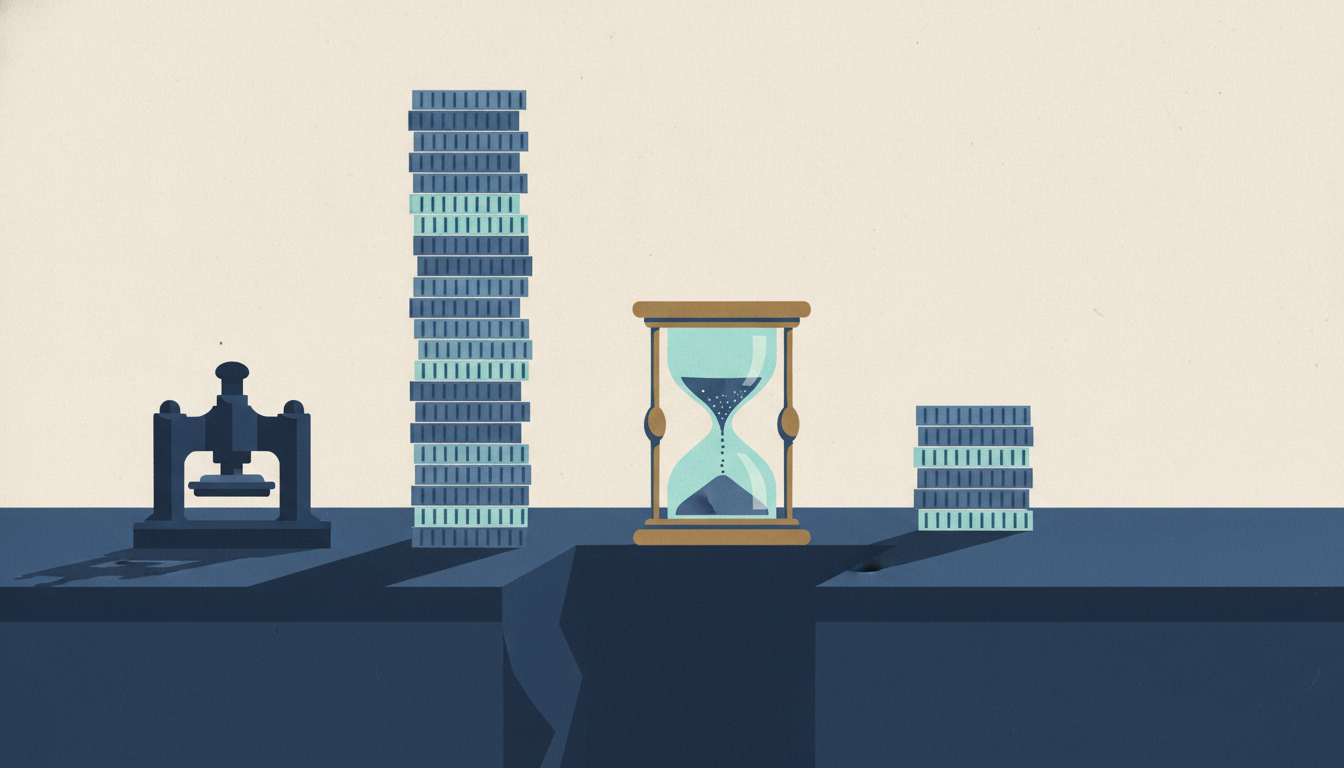
International Money Express (Nasdaq: IMXI), the remittance company known as Intermex, closed at $9.66 on October 19, 2026, far below the $16.00 per share in cash that Western Union agreed to pay. Special-situations investor Rod Alzmann is long the spread and thinks the deal is more likely than not to close. The open question is whether California's financial regulator reinstates its approval before the November 10, 2026 outside date.
This is journalism and commentary, not investment advice. We hold no position unless stated.
Key facts
- Ticker and exchange: International Money Express, Inc., IMXI, Nasdaq.
- Situation type: merger arbitrage; an all-cash takeover by Western Union (NYSE: WU) signed August 10, 2025.
- The call: long, from Rod Alzmann (@RodAlzmann), who now holds a small position after cutting it in half near $11.50.
- The spread: $16.00 versus a $9.66 close on October 19, 2026, a gross gap of $6.34, or about 66%.
- What's left: reinstated approval from California's Department of Financial Protection and Innovation (DFPI) and a new federal antitrust waiting period.
- Key date: November 10, 2026, when either side can walk away, as automatically extended under the merger agreement.
- Main risk: California never reinstates its approval and the deal dies, leaving a shrinking business.
Is IMXI a good bet right now?
The case for IMXI is a 65.6% gross return if the deal closes at $16.00. The case against is that the market is pricing a large chance the deal fails, and Intermex would likely fall if it does.
Rod Alzmann has put a number on that downside. In a September 24, 2026 reply, he wrote that Intermex would trade "with a six handle" in a break, meaning somewhere in the $6 range.
Why are investors bullish on Intermex?
- Almost everything is done. An October 2, 2026 8-K says all regulatory approvals have been obtained except the California DFPI approval and a new Hart-Scott-Rodino waiting period.
- Shareholders already voted yes. Intermex stockholders approved the merger on December 9, 2025, according to the company's second-quarter 10-Q.
- California approved once. The DFPI extended its approval on July 31, 2026, then suspended that extension on August 13, citing the six months since the original approval, both companies said.
- Both sides say they are committed. Western Union and Intermex said they intend to close promptly after reinstatement.
Who's making this call and why?
Rod Alzmann describes himself as a private investor in special situations whose tax edge differs from his readers'. He held Intermex before the deal and sold near $16 in 2025. On September 24, 2026 he wrote: "I'm long, I think it's more likely than not that it closes."
On October 1 he cut his position by about half near $11.50, citing uncertainty and the tight calendar. On October 20 he said he still holds a small allocation of under 1% of his portfolio.
Track record. In our tracking, Rod Alzmann is 5-5 (a .500 win rate) on 10 calls scored at 180 days against the S&P 500, with an average edge of about -19.02 percentage points. He is unranked on the career table. See the scoreboard.
Other voices:
- Japan Deep Value (@JapanDeepValue1), a Japan value investor, wrote on October 19: "Not sure I have ever seen a spread this large with so many boxes ticked already."
- Essential (@essential6t7), an anonymous account that tracks the California review, argued that the state's change-of-control test covers character, competence and compliance, not competition: "I expect a negotiated package, not a block." On October 19 the account added that Western Union's deal financing expires November 10: "Delay isn't free."
Who disagrees?
- The price itself. Niko (@lngspt) wrote in September: "if the spread is pricing the deal as dead, usually there's a good reason for it."
- A new regulator. The ArbLens newsletter summarized an October 12 CTFN report linking the pause to new leadership above the DFPI, including Rohit Chopra, the former CFPB director. ArbLens dropped IMXI from its top ideas, writing that "a 55% spread already prices a high chance of failure." Intermex fell from $12.67 to $10.87 that day.
- A weaker business. Second-quarter 2026 revenue fell to $131.2 million from $161.1 million a year earlier, and net income fell to $4.2 million from $11.0 million, per the 10-Q.
- The break fee may not help. The 10-Q describes a $27.3 million fee Western Union would pay if the deal ends over antitrust problems. It is not clear from the filing whether a California licensing refusal would trigger it.
What are the key facts to verify?
- The October 2, 2026 8-K on the refiled HSR notice and the DFPI status.
- The August 13, 2026 update quoting the DFPI letter.
- The second-quarter 10-Q for the $16.00 price, the November 10 outside date and the termination fees.
What would prove it right or wrong?
Right: the DFPI reinstates its approval, possibly with fee or location conditions, the HSR period ends, and the deal closes at $16.00.
Wrong: California stays silent past November 10, Western Union lets the agreement lapse, or the price is cut.
This is journalism and commentary, not investment advice. We hold no position unless stated.