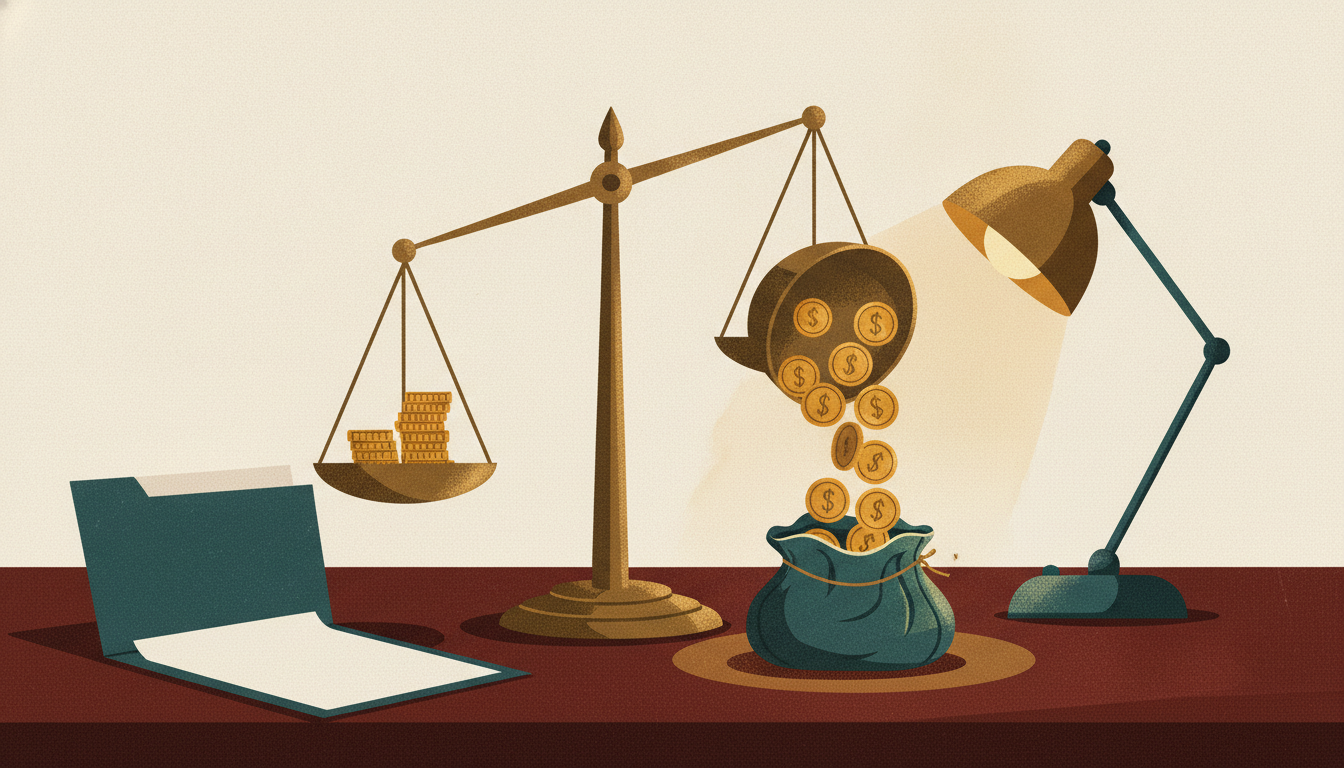
The lender struck one clause, and the whole deal wobbled. Rae (a made-up buyer) had shaken hands on Saltmarsh Bike Co. (a made-up repair shop) three weeks earlier. The seller wanted $750,000 at closing plus $150,000 more if year-one revenue cleared $1.1 million. Totally normal in a regular acquisition. In an SBA 7(a) deal, it's a dead clause.
This is general information, not legal or financial advice. Confirm every rule with your lender and the current SOP before you sign a letter of intent.
The one tip
SBA SOP 50 10 8.1 (effective October 1, 2026), Appendix 15, says it flat out: seller earnouts are prohibited in 7(a) change-of-ownership deals. But the same sentence opens a door. Buyer rebates based on business performance are allowed, because they protect the borrower.
So don't fight the lender. Flip the earnout into a rebate.
An earnout says: "I pay you more if the business does well." A rebate says: "You pay me back if the business does worse than you promised." Same bet, opposite direction, and only one of them clears SBA.
Here's what the SOP attaches to a rebate:
- Any rebate cash the seller pays you must go toward principal on the 7(a) loan that funded the purchase.
- Paying it to principal does not trigger SBA's subsidy recoupment (prepayment) fee.
- A working capital true-up in the purchase agreement is not a rebate. That cash fixes a working capital shortfall at closing, so you can keep it in the business.
Worked example
Flipped deal: price $900,000, all at closing. If year-one revenue comes in under $1.1 million, the seller pays Rae back $150,000.
Rae adds $60,000 of working capital, so total project cost is $960,000. An Initial Acquisition needs at least a 10% equity injection on total project cost, and SBA says that can't be reduced. That's $96,000 from Rae. The 7(a) loan is $864,000.
Assume 10.5% over 10 years (an assumption, not a quote). The payment is about $11,658 a month, or $139,901 a year. Initial Acquisitions need debt service coverage of at least 1.25 to 1, so the shop needs about $174,876 of cash flow for debt service. Saltmarsh showed $210,000 last year, which is roughly 1.50x. It works.
Now year one lands at $1.02 million. The seller owes the $150,000 rebate, and all of it goes to principal:
- The balance after 12 payments is about $812,382.
- After the rebate, it drops to about $662,382.
- At the same $11,658 payment, the loan is paid off in about 79 more months instead of 108. That's roughly two and a half years early, with no SBA prepayment fee.
- If the lender agrees to re-amortize instead (their call, not an SBA rule), the payment drops to about $9,506.
One catch. The business valuation the lender orders still has to support the full $900,000. If the valuation comes in lower, the gap has to be your equity.
Do this week
- Search your letter of intent for "earnout," "contingent payment," and "deferred consideration." Flag every one.
- Rewrite each as a buyer rebate: same revenue target, with the seller paying you if the business misses it.
- Have your deal attorney add language that rebate cash goes to 7(a) principal.
- Keep any working capital true-up in its own clause so nobody confuses it with a rebate.
- Check the seller's role too. Under Appendix 15, the seller in an Initial Acquisition can't stay on as an employee or owner, but you can hire them as a consultant for up to 24 months total.
- Send the revised LOI to your lender before you pay for the valuation.
Same bet. Opposite direction. Only one of them gets funded.
Sources
- SBA SOP 50 10 8.1, Appendix 15 (7(a) Changes of Ownership: earnouts and buyer rebates, working capital true-ups, seller transition and consultant limit, business valuation, equity injection and DSC for Initial Acquisitions): SBA's SOP 50 10 page
- SBA 7(a) loan types overview: SBA's 7(a) loans page
- More in the series: SBA 7(a) Playbook
Verified against SOP 50 10 8.1 text: October 26, 2026.
