Last updated: October 2026. General information only.
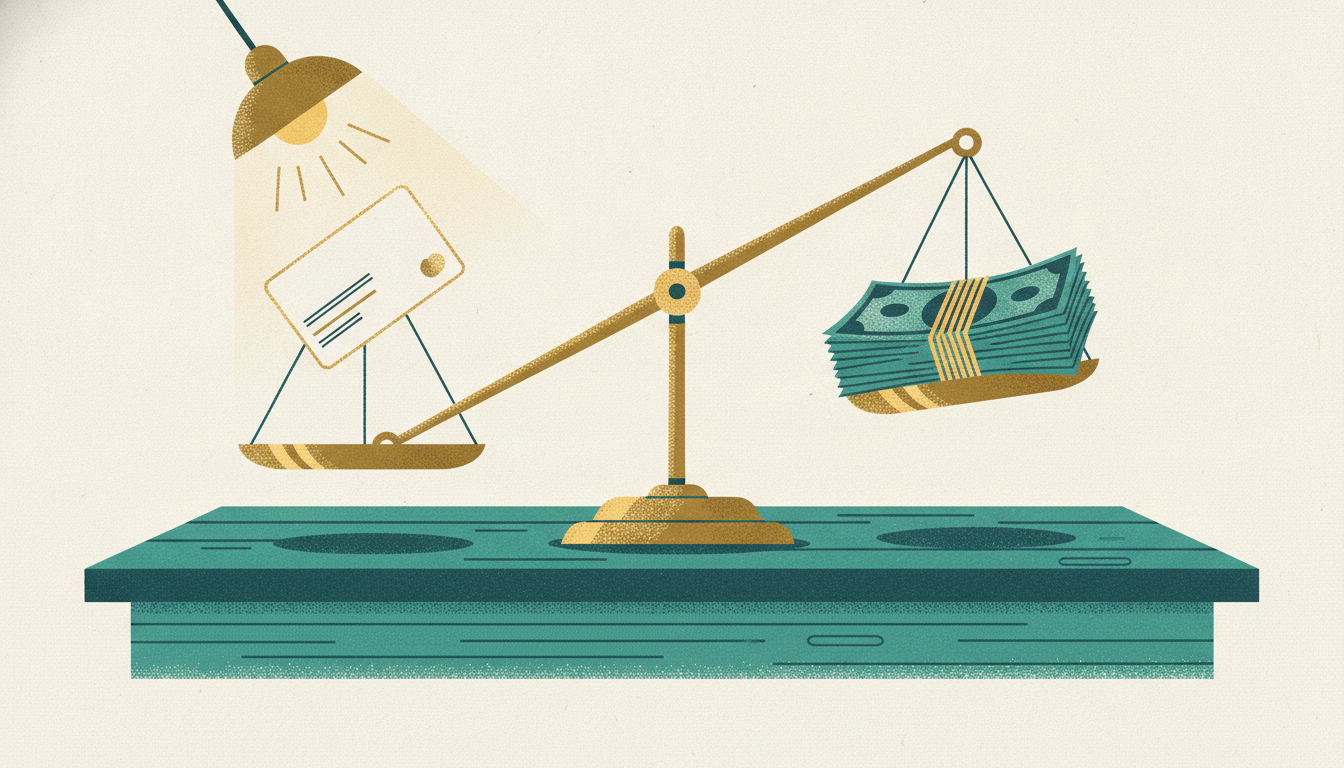
For everyday costs you can pay off within a few statements, a business credit card is usually the cheaper choice, and paying the full balance each month can mean no interest at all. A merchant cash advance gives you a lump sum fast, even with weaker credit, but it usually costs much more and takes money out daily or weekly. In 2026, compare both in total dollars.
The short version
| Point | Business credit card | Merchant cash advance |
|---|---|---|
| What it is | A revolving line you draw on as you spend | Cash now for a slice of future sales |
| How you pay | A monthly statement with a minimum payment | Automatic daily or weekly debits |
| Cost | Interest only on balances you carry, and none if paid in full by the due date | A fixed payback amount that is often much higher |
| Paying early | Lowers the interest you pay | Ask whether it lowers the total you owe |
| How much you can get | Set by your credit limit | Often based on your sales |
| Speed | Fast once the card is open | Often fast |
| What a slow month does | The minimum payment is still due | Debits can keep coming unless there is an adjustment clause |
| Who it usually fits | Owners with routine costs they can pay off soon | Owners who need a larger sum this week or were turned down |
How a business credit card works
A business credit card gives you a credit limit. You spend against it, and each month you get a statement with a minimum payment and a due date.
Many cards give a grace period on purchases: if you pay the full statement balance by the due date, you pay no interest on those purchases. Check your agreement to see how your card handles this.
If you carry a balance, interest is charged on what you carry. Most cards also ask the owner for a personal guarantee, which means you can be on the hook if the business cannot pay.
Business cards have fewer federal protections than personal cards
Many owners assume a business card comes with the same rules as a personal card. It usually does not.
In its report to Congress on small business credit, the Federal Reserve Board wrote that "the substantive protections and disclosure requirements for credit cards under the Truth in Lending Act (TILA), 15 U.S.C. 1601 et seq., do not apply to business credit card accounts."
In plain words, a business card can come with fewer of the rate-change and fee rules that many owners expect from a personal card.
The takeaway: read your cardholder agreement as carefully as you would read an MCA contract. Look at how and when the rate can change and what fees apply. This is general information, not legal advice.
A credit card cash advance is not a merchant cash advance
The names sound alike, but they are different products.
A credit card cash advance is cash you take out on your card. It usually has its own higher rate and a fee, and usually no grace period. Check your cardholder agreement for the terms.
A merchant cash advance is a separate product from a funder that buys a slice of your future sales. Read is a merchant cash advance a good idea for more.
When each one tends to fit
A business credit card tends to fit:
- Recurring supplies and small costs
- Travel
- Inventory you can pay off soon
- Building a payment history for the business
A merchant cash advance tends to fit only when:
- You need a larger amount this week
- A bank or card issuer already said no
- Your sales can carry daily or weekly debits
If an MCA is truly the only option, check these first:
- The total you repay
- How often money comes out
- Whether an adjustment (reconciliation) clause lowers payments in slow months
- What fees come off the top
- What the early-payoff terms are
- Whether a second advance is being stacked on top of one you already have
Read the MCA contract clauses guide before you sign.
Cheaper options to check before an MCA
- A bank line of credit: line of credit vs MCA
- SBA loan vs a merchant cash advance
- SBA microloans, with details on SBA.gov
- CDFI business loans from mission-based lenders
- Bad credit business loans
- Fastest business funding
- Startup business funding
How to compare a card and an MCA in dollars
- Step 1: Cash you actually get after fees.
- Step 2: Total you will repay over the time you expect to carry it.
- Step 3: Dollar cost, which is total repaid minus cash received.
- Step 4: How much leaves your account per week or month.
- Step 5: An estimated APR from each provider, in writing.
Here's a hypothetical, with round example numbers only. Corner Lantern Print Shop is a made-up business that needs cash for supplies. In this example, an MCA gives it $10,000 and it repays $13,000, so the example dollar cost is $3,000. In the same example, it puts $10,000 on a card and repays $10,500 over a few months, so the example dollar cost is $500. These are examples, not quotes.
Run your own figures in the cost of capital calculator.
What some state regulators now require MCA providers to show you
The New York State Department of Financial Services adopted its Commercial Finance Disclosure Law regulation on February 1, 2023. It appears as Part 600 of the state's regulations (23 NYCRR Part 600) and covers certain commercial financing up to $2,500,000.
The California Department of Financial Protection and Innovation lists the disclosures required for commercial financing, including total funds provided, total dollar cost, the term or estimated term, and how and how often payments are made.
Wherever you are, ask for the disclosure in writing. This is general information, not legal advice.
Already have an MCA or getting broker calls?
- How to refinance a merchant cash advance
- Merchant cash advance alternatives
- How to stop MCA broker calls
Every other way to fund your business
See every way to fund your business
Also compare merchant cash advance vs business loan, revenue-based financing vs merchant cash advance and what to do after a business loan is denied.
Sources
Checked on FederalReserve.gov, SBA.gov, DFS.NY.gov and DFPI.CA.gov on October 21, 2026.