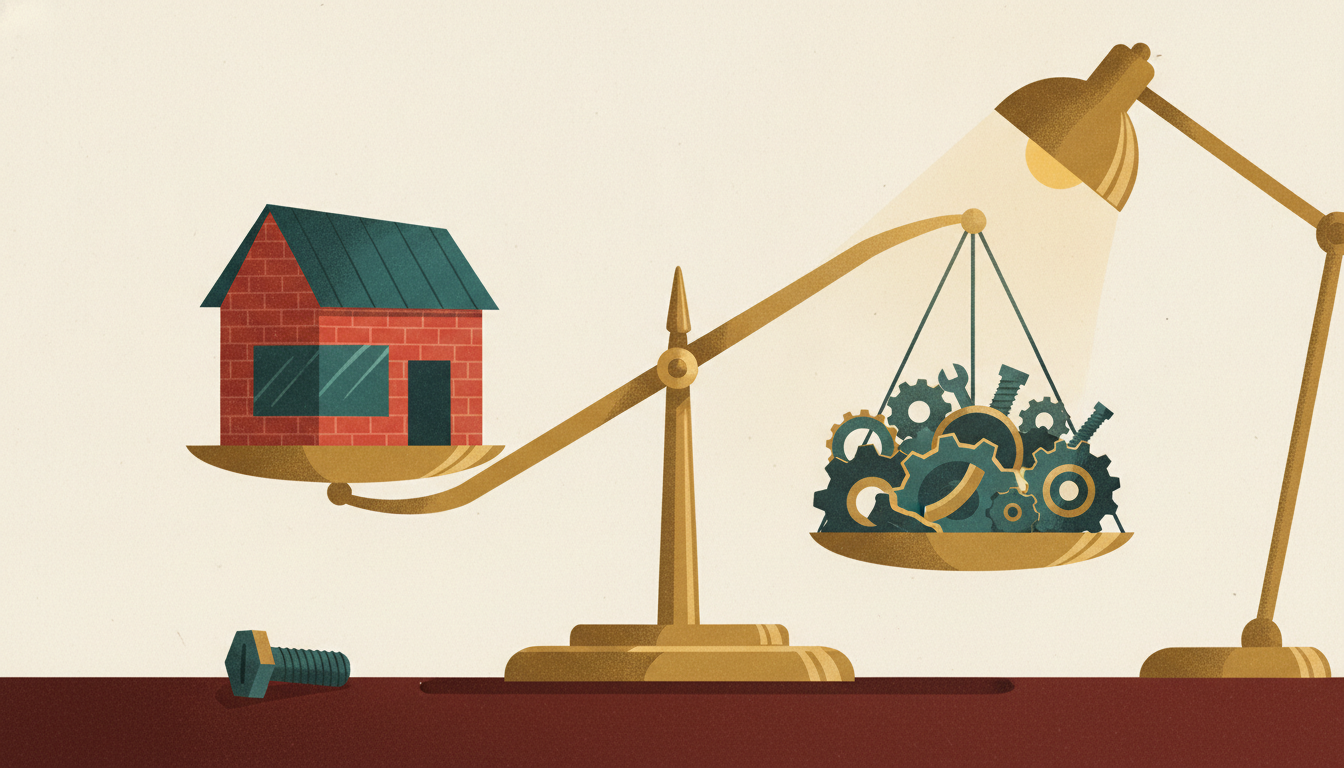
Your SBA loan's term isn't picked from a menu. It's set by what the money buys, and a few percentage points of real estate can decide whether underwriting says yes.
Here's a hypothetical. Juno (a made-up founder) had a $1,000,000 SBA 7(a) request to buy the building her bakery rents, plus new ovens and working capital. The lender ran the numbers at about 17 years, not the 25 she'd been quoting to friends. Her debt service coverage came out at 1.10. The minimum is 1.15. The deal stalled in underwriting over 3 percentage points of real estate.
This is general information, not legal or financial advice. Confirm every rule against the current SOP and your lender before you sign anything.
The one tip
SBA sets maximum terms by use of proceeds. Under SBA SOP 50 10 8.1 (Appendix 17, effective October 1, 2026), working capital, inventory and goodwill top out at 10 years. Equipment generally tops out at 10 years, or up to 15 if the IRS asset class useful life supports it. Real estate, including buying, renovating or building, can go up to 25 years.
When one loan pays for a mix, the SOP gives two options. The lender can use a blended maturity, which in practice is a weighted average of each use's term by dollars. Or, if 51% or more of the loan's proceeds go to real estate, the maximum maturity can be up to 25 years for the whole loan.
That 51% line is the lever.
Cross 51% real estate and every dollar can stretch to 25 years. Miss it and your working capital and equipment drag the term down.
Two catches. First, 25 years is a ceiling, not a promise. The SOP says the term must be the shortest appropriate one based on use of proceeds and your ability to repay, and your lender's own policy can be stricter (that's a lender overlay, not an SBA rule). Second, the 51% option does not apply to buying a business. More on that below.
Worked example
Juno's existing bakery, Quillfeather Bakehouse (a made-up business), will occupy the whole building, which keeps it clear of SBA's occupancy rules. It asks for $1,000,000:
- $480,000 To buy the building (48%)
- $320,000 For ovens and equipment (32%)
- $200,000 For working capital (20%)
Real estate is 48%, so no 25-year option. Blended: ($480K x 25 + $320K x 10 + $200K x 10) / $1M = 17.2 years, call it 17. At an assumed 10% rate (an assumption for the math, not a quote), the payment is about $10,212 a month, or $122,544 a year. Her cash flow available for debt service is $135,000, so her DSCR is 1.10. SOP 50 10 8.1 requires at least 1.15 for Standard 7(a) loans.
Now she covers $60,000 of the working capital from cash she already has. The loan drops to $940,000, and the building is now 51.1% of it. The lender can go up to 25 years. Same assumed 10%: about $8,542 a month, or $102,504 a year. DSCR: 1.32.
The honest trade-off: over the full term, the 25-year loan costs about $1.62M in interest versus about $1.08M for the 17-year one. A longer term buys monthly breathing room, not a cheaper loan. And since both terms are 15 years or longer, prepaying more than 25% in any one year during the first 3 years means you'd owe SBA the Subsidy Recoupment Fee.
Buying a business? Different math
For any change of ownership, Appendix 15 governs and the 51% option is off the table. Buy a $1.2M business that includes a $700,000 building and $500,000 of everything else. That's 58% real estate, but you don't get 25 years on all of it. The blend is ($700K x 25 + $500K x 10) / $1.2M = 18.75, rounded to 19 years. The SOP says that math happens before any equity injection is applied. The one exception is an owner-occupied special purpose property where real estate is 85% or more of total project costs.
Do this week
- Build a use-of-proceeds table: real estate, renovation, equipment, working capital, soft costs. Put a dollar figure and a percentage on each line.
- If real estate is in the 45% to 50% range, see what moves you over 51%. Funding some working capital from cash is one way. Don't inflate the building price to get there. The appraisal and purchase contract will show the real number.
- If you own the building, renovation of it counts as real estate under Appendix 17. Make sure it isn't filed as equipment.
- For long-life equipment, ask whether the IRS asset class useful life supports more than 10 years.
- Ask your lender: "What maturity are you underwriting, and is your policy shorter than the SBA maximum?"
- Run your DSCR at the term the lender quotes, not the term you hope for.
Sources: SBA SOP 50 10 8.1, Appendix 17 (7(a) Loan Maturity Requirements), Appendix 15 (7(a) Changes of Ownership, Loan Maturities) and Section B, Ch. 1 (Standard 7(a) repayment ability and DSCR), download from https://www.sba.gov/document/sop-50-10-lender-development-company-loan-programs ; 13 CFR 120.212 (loan maturities), https://www.ecfr.gov/current/title-13/section-120.212 ; SBA 7(a) terms, conditions and eligibility, https://www.sba.gov/partners/lenders/7a-loan-program/terms-conditions-eligibility
Verified against SOP 50 10 8.1 text (Appendix 15, Appendix 17 and Section B, Ch. 1): October 16, 2026.