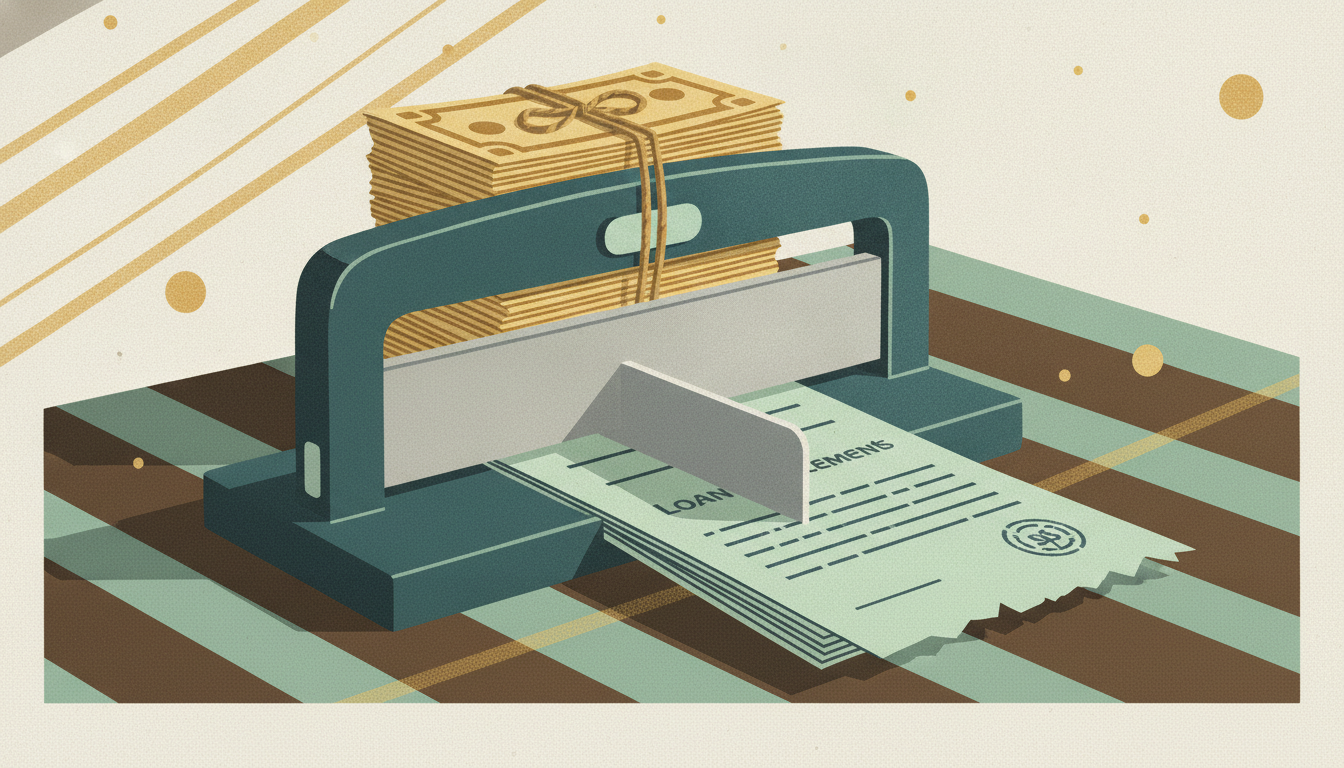
Got six figures in a brokerage account and an SBA loan request in the works? Your lender will see that account, and it can shrink the loan.
Here's a hypothetical. "You have $210,000 sitting in a brokerage account. Why do you need $300,000 from us?" Ravi (a made-up founder) had a quote for a used press, a lease renewal and a spreadsheet that worked. He did not have an answer to that question. His SBA 7(a) request came back cut in half.
This is general information, not legal or financial advice. Confirm every rule against the current SOP and your lender before you sign anything.
The one tip
SBA only backs loans you can't get from private sources on reasonable terms. That's the "credit not available elsewhere" test, and it has two sides. Most founders only prepare for one.
Side one is your own money. Under SBA SOP 50 10 8.1 (Section A, Ch. 1, Para. H, effective October 1, 2026), the lender has to show that some or all of the loan can't come from the liquid assets of every 20%+ owner, their spouses and minor children, and the business itself. The SOP lets owners keep reasonable funds for future medical costs, education (including the kids') and retirement. The business can keep reasonable funds for working capital and for capital expenses over the next 24 months. The SOP doesn't give a dollar formula for "reasonable." Your lender decides and writes it into the credit memo. So yes, too much cash in the bank can shrink your SBA loan.
Side two is the bank. The lender must name a specific weakness that keeps you from a regular loan: you need a longer term than its policy allows, the collateral falls short of its policy, the business is 2 years old or less, the loan is over its limit for one customer, or another factor it explains in writing. Too strong for a regular loan means not eligible for SBA. And a lender can't cite your credit score missing its policy as the only reason.
Worked example
Here are Ravi's numbers. He owns 100% of Pebblewick Print Co. (a made-up print shop), open 4 years. He asks for a $300,000 7(a) Small loan (the 7(a) Small ceiling is $350,000) for a used press and working capital. His weakness is real: the bank's regular equipment loans cap at 5 years, and he needs 10 to make the payment work.
His personal financial statement, which the SOP requires from guarantors (with narrow exceptions), lists:
$210,000 In a taxable brokerage account
$95,000 In a 401(k)
$38,000 In a 529 plan for his daughter
$70,000 In business checking
The lender treated the 401(k) and the 529 as the retirement and education set-asides the SOP allows. The $70,000 stays as working capital. The brokerage account is the problem. Ravi called it his house down payment fund, but a house isn't one of the set-asides the SOP names. This lender (its judgment, not an SBA number) left him a $60,000 personal cushion and asked him to put $150,000 into the project.
The loan dropped to $150,000. At an assumed 10.5% over 10 years (an assumption for the math, not a quoted rate), the payment fell from about $4,048 to about $2,024 a month. That's about $93,000 less interest over the life of the loan. It also meant $150,000 of his own cash went into a printing press. He hadn't planned for that, and he found out after the press deposit was already paid.
Do this week
List every liquid account for every 20%+ owner, each spouse, any minor children and the business: checking, savings, CDs, brokerage. That's roughly what your lender will see on the personal financial statement.
Tag each dollar. Retirement, education and medical are the owner set-asides the SOP names. For the business, write a 24-month capital expense budget and a working capital number, with quotes behind them.
Ask your lender before you apply: "How do you treat owner liquidity in the credit elsewhere test, and how much cushion do you usually leave?" The answer is lender policy, so get it in writing.
Ask which weakness they plan to cite: term, collateral, time in business, loan size or something else. If the only answer is your credit score, that alone doesn't meet the SOP.
Run your payment at the full loan amount and at the smaller amount you'd get if part of your cash has to go in. Make sure both still work.
Don't move or hide money to pass the test. You sign the personal financial statement, and it has to be dated within 90 days of loan approval. Report what you actually have and make the case for your set-asides instead.
More in the SBA 7(a) Playbook.
Sources: SBA SOP 50 10 8.1, Section A, Ch. 1, Para. H (Credit Not Available Elsewhere) and Section A, Ch. 5 (personal financial statements from guarantors), download from https://www.sba.gov/document/sop-50-10-lender-development-company-loan-programs ; 13 CFR 120.101 (credit not available elsewhere), https://www.ecfr.gov/current/title-13/section-120.101 ; SBA 7(a) terms, conditions and eligibility, https://www.sba.gov/partners/lenders/7a-loan-program/terms-conditions-eligibility
Verified against SOP 50 10 8.1 text, 13 CFR 120.101 and the SBA.gov 7(a) terms page: October 15, 2026.