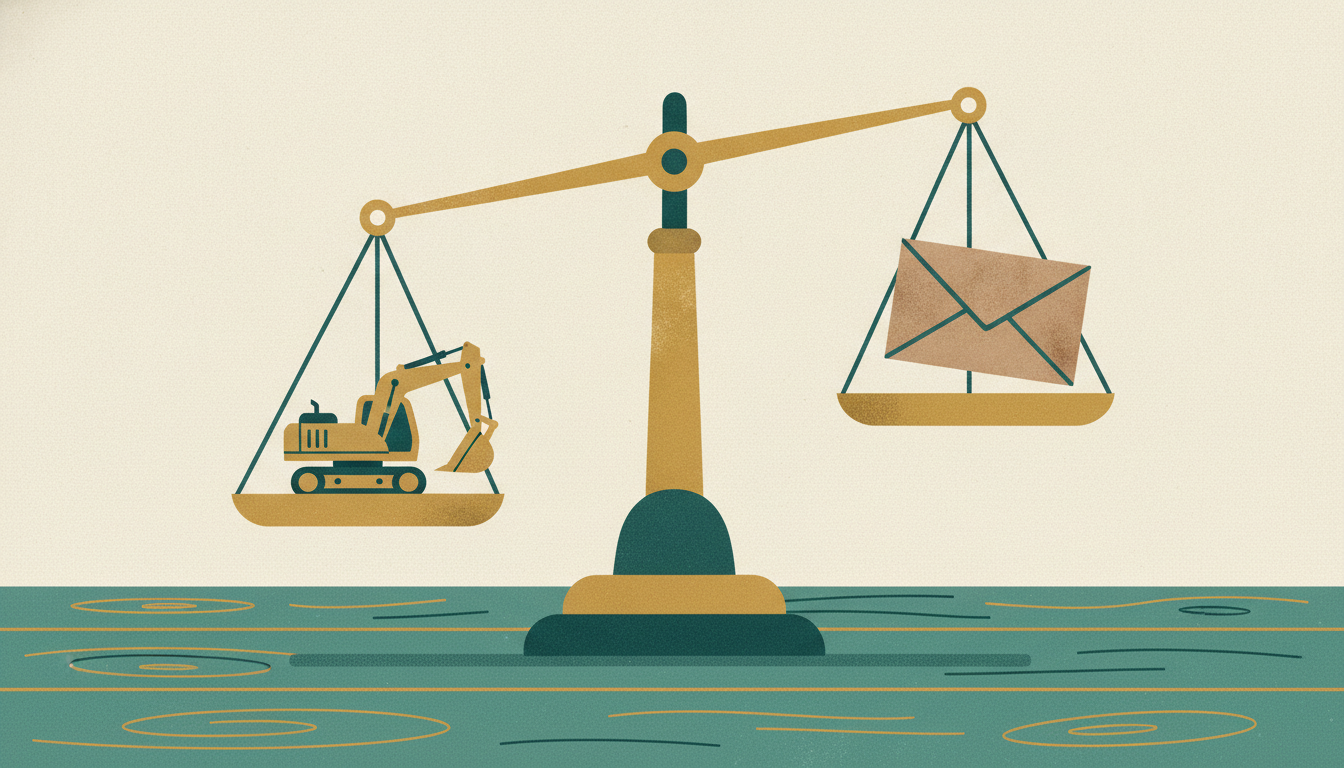
The excavator on the lot costs $210,000. The bank account says $260,000. Payroll runs every Friday.
A contractor with the cash to buy outright should weigh liquidity against interest. The decision factor is what that cash covers: payroll, materials and retainage gaps that a paid-off machine can't. If you already paid cash, a cash-out refinance or sale-leaseback can release equity, but one adds a lien and the other transfers title.
General info, not legal, tax or financial advice.
Why would you finance when you can pay cash?
Because a machine can't make payroll. Cash can.
Construction cash comes in late. Draws slip, retainage sits with the owner until closeout, and materials get paid before you bill. Cash in the bank covers those gaps. Cash poured into a machine sits there until you sell it or borrow against it.
Financing costs interest. Running out of cash can cost a job, a crew or a supplier account. Put a number on both.
What does the math look like?
Worked example
All names and numbers are made up.
Granite Ridge Excavating has $260,000 in the bank and wants a $210,000 excavator. Monthly payroll and overhead run about $64,000. The company has $55,000 in retainage waiting on two closed jobs.
Pay cash: $50,000 left. That is less than one month of payroll and overhead, with $55,000 tied up in retainage.
Finance: 20% down is $42,000. The remaining $168,000 at 8% over 60 months is about $3,406 a month. Total interest is about $36,386. The company keeps $218,000 in the bank.
So the choice is about $36,386 in interest over 5 years against a $50,000 cushion today. At $64,000 a month, one slow draw could burn that cushion in about three weeks.
If Granite Ridge had $600,000 in the bank and steady draws, paying cash would look very different. Same machine, different answer.
Can you pull cash back out of a machine you paid off?
Sometimes, yes. There are two main routes.
- Cash-out refinance. A lender lends against the machine's appraised value and files a lien on it. You keep title. You owe payments again.
- Sale-leaseback. You sell the machine to a lessor and lease it back. Title moves to the lessor. You keep using it and make lease payments.
Both take time. The lender or lessor will want an appraisal, serial number, hours, photos and proof there are no liens on the machine. Don't plan payroll around one closing fast.
What tax issues come with a sale-leaseback?
If a sale-leaseback is treated as a sale for tax purposes, depreciation you already took can come back as income.
The IRS says gain on the sale of section 1245 property, including a sale and leaseback, is treated as ordinary income up to the depreciation allowed or allowable: https://www.irs.gov/publications/p544
So if you took Section 179 or bonus depreciation on the excavator, its tax basis may be near zero. Selling it to a lessor could create a taxable gain. A cash-out refinance is a loan, not a sale. Depreciation rules are in Publication 946: https://www.irs.gov/publications/p946
Ask your CPA to run both before you sign anything.
What should you check this week?
- List the next 90 days of payroll, materials and expected draws.
- Find the lowest bank balance in that stretch under each option.
- Get a written loan quote before you pay cash.
- If you already paid cash, ask a lender for a refinance quote with the appraisal method in writing.
- Ask your CPA how a sale-leaseback would hit this year's taxes.
SBA 7(a) loans can be used to buy machinery and equipment through a lender: https://www.sba.gov/funding-programs/loans/7a-loans
Equipment loans, refinances and sale-leasebacks are not merchant cash advances: https://mcafax.com/notebook/equipment-financing-vs-merchant-cash-advance
More on the machine choice: buy, lease or rent at https://mcafax.com/notebook/contractor-buy-lease-or-rent-excavator and down payment basics at https://mcafax.com/notebook/contractor-equipment-down-payment. The contractor funding guide: https://mcafax.com/notebook/construction-business-loans. Funding types side by side: https://mcafax.com/notebook/where-to-get-business-funding
